Race Intel · QT2 Systems
2026 Patriot Half
Five Cornerstones Course Guide · Saturday, June 13, 2026 · East Freetown, MA · USAT Long Course National Championship · Your complete race execution breakdown from the QT2 coaching staff.
The Patriot Half has been New England's best long-course triathlon for twenty years — recognized three times as "Best Small Race" in the Triathlete's Choice Awards and operating with the kind of precision and care that keeps athletes coming back. In 2026 it earns its most significant stage yet: the USAT Long Course National Championship. That designation changes the field composition. Expect faster athletes, sharper competition, and qualification slots on the line for the 2027 Long Course World Championship in Edmonton (triathlon and aquabike) and Zofringen (duathlon). The course itself is honest. The swim is clean, the bike is flatter than most 70.3 courses, and the run is a single loop through country roads with enough rolling grade to find gaps in preparation. This guide applies QT2's Five Cornerstones directly to Patriot. Use it to race the course in front of you — not a generic 70.3 template.
Training
If you're reading a course guide two weeks out, the fitness question is settled. You built what you built. The work now is to arrive sharp — not to squeeze in one more block your body cannot absorb before the race anyway.
The Patriot bike is deceptively approachable on paper. Roughly 1,430 feet of elevation over 54 miles sounds manageable, and it is — if you respect it. The course isn't defined by a single brutal climb. It's defined by sustained rolling terrain that accumulates cost quietly, especially inside the double-loop section where you pass the same grades twice. Athletes who trained on flat roads will feel fine through mile 20. By mile 40, the deficit shows.
The run is a single loop with just enough grade to punish athletes who arrive at T2 already overcooked. There is one ill-timed hill at mile 12.5 — late enough that it will find whatever you have left. A course that looked flat on the elevation profile will not feel flat there.
Race week protocol
Race week, aim to stay sharp with two short sessions with race-pace efforts to keep race feel while avoiding anything that accumulates fatigue. By Friday evening, your legs should feel slightly coiled — that edge of readiness that tells you the taper worked. Don't panic if you feel flat on your shakeout workouts either; flat on race eve often means fast on race day. Above all, this is not the week to prove fitness. Your fitness is already decided. The goal is to arrive at the starting line sharp, not to cram one more training block into a body that needs to rest.
Logistics note: Transition opens at 5:00am. Packet pickup is available Friday 3:00–6:00pm at Cathedral Camp (167 Middleboro Road, East Freetown, MA) and race morning from 5:00–6:30am. There is an optional Friday bike drop available under overnight security — a genuine convenience worth using. The athlete panel and Q&A with the race director runs Friday at 5:00pm; the practice swim runs 5:30–6:30pm. On race morning, all athletes must be in transition by 6:50am for the procession to the swim start.
Restoration & Day-to-Day Nutrition
Race week is a deposit, not a withdrawal. Sleep quality, stress management, and daily nutrition in the 10–14 days before the race determine how much fitness you actually get to use. One bad night of sleep the day before the race is recoverable — and generally quite normal, as race nerves often compromise that night anyway. A week of poor sleep, disrupted eating, and unmanaged stress is not.
Two nights before race day matter more than most athletes acknowledge. Bank extra sleep Wednesday and Thursday nights, add naps where you can, and stay on top of hydration all week — not just the 24 hours before. Don't show up to the starting line short on hydration and expect to recover.
Race week nutrition framework
If you haven't practiced your race morning nutrition protocol on a long training day yet, do it on your last big Saturday before taper. Your gut needs to know what's coming as much as your legs do.
Fueling
The race is four to eight hours. Fueling on the Patriot bike is more forgiving than on a technical course, and that manageability creates a trap: athletes underestimate what the body is spending and arrive at T2 already behind. Mid-June in southeastern Massachusetts can mean heat and humidity are in play. Heat slows gastric emptying, increases sweat sodium losses, and drives fluid requirements up. The plan that worked in early spring training does not automatically transfer to race day conditions.
On-course resources
The bike has one aid station at miles 26 and 44 offering water and Gatorade Endurance in 24oz sport-cap bottles via a bottle exchange. Carry a minimum of two bottles from T1, and use the exchange as a supplement — not your primary strategy. On the run, 6–8 aid stations are spaced across the course offering water, Gatorade Endurance, Coke (flat), ice, electrolyte capsules, and Huma gels at select stations. Use your training product on the bike. Introduce on-course product only if you've trained on Gatorade Endurance — if you haven't, carry everything you need and use water only at aid stations.
Start fueling within the first 15 minutes on the bike. Your body digests and utilizes nutrition far more efficiently on the bike than on the run. Getting behind on calories or sodium on the bike is a problem you cannot solve on the run.
On a hot day: pour water over the back of your head at every aid station — not the front. Water down the front gets into your shoes and creates blisters on a 13-mile run. Keeping your core temperature down directly preserves your ability to push pace in the second half of the run.
Pacing
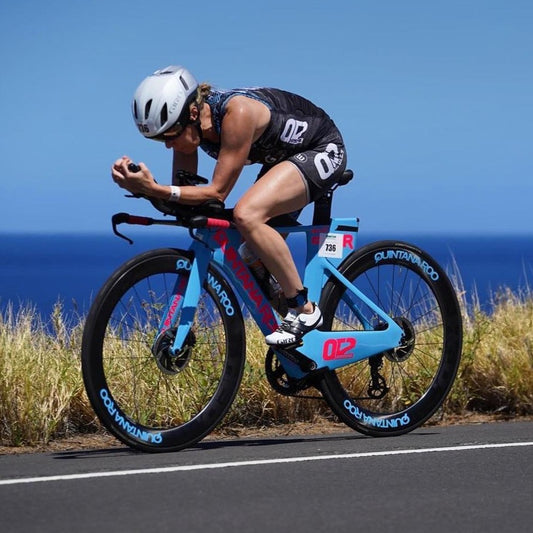
The Patriot bike looks flat. It isn't. The rolling terrain across 54 miles, ridden twice through the loop section, accumulates cost the same way any variable-terrain course does — quietly and cumulatively. The athletes who surge every grade and soft-pedal every descent are spending energy they haven't earned yet. The athletes who ride smooth, consistent power collect.
Swim
Long Pond is calm, fresh water with easy sighting and a counterclockwise rectangular layout — two left turns, orange buoys marking the course, yellow at the turns. Execute in aerobic control. The rolling time-trial start (3 athletes every 10 seconds, self-seeded) means your clock starts when you cross the timing mat at the water's edge. Seed yourself accurately — not where your ego puts you, where your actual swim pace puts you. Drafting off similar-speed swimmers is a meaningful advantage; overseed and people swim over you, underseed and you burn energy going around them.
If you skip the 6:00am warm-up swim, do calisthenics — jumping jacks, high knees, running in place — for about 10 minutes before entering the water. This pre-builds lactate and prevents the heart rate spike that makes the first 200 meters feel like a panic. In the final 100–200 yards of the swim, add light leg kicking to drive blood flow into the legs before you stand up and run to transition.
Bike: the rolling terrain and the double-loop test
The first 12 miles are completed once before entering the loop. The loop itself is approximately 19–20 miles and is ridden twice before the final 4-mile stretch back to T2. The defining navigation moments are The Merge and The Split — know both before race day.
Volunteers and police details will be present at both intersections, but you should know the course before you arrive at them. Do not rely on reading a sign at race pace in a group of riders.
If you think you can hold a given wattage for the full 54 miles at mile 5, back off 2–3% from that number. It will catch up to you if you don't. The Patriot run course does not reward athletes who arrive at T2 already spent.
Run
Start 5% slower off the bike than your target run pace. Mile one will feel wrong regardless of how well you biked. Mile two, you'll start to find your legs. By mile three, you'll forget there was a bike course. That's the physiology — don't fight it, plan for it.
Mental Fitness
Mental fitness in a 70.3 isn't just about motivation — it draws on decision-making under fatigue. The decisions you make when the going gets tough — at mile 40 on the bike, at mile 10 of the run — are what separate a well-executed race from one that leaves you searching for explanations afterward.
This is a USAT National Championship, which means the field will be faster and deeper than a typical regional 70.3. That context can work for you or against you. The athletes who run into trouble at championship-level races typically do it early — they get caught up in the competition and go out too hard on the bike because the field around them is going hard. Every one of those decisions comes with a later cost. The athletes who race their own numbers — their power targets, their pace targets, their fueling intervals — regardless of what's happening around them, are the athletes still running well at mile 11.
Pre-race mental preparation
Confidence before a race isn't about the absence of nerves — it's derived from the presence of a plan you've rehearsed. Before race day, run the race in your head: the swim start, T1, the first miles of the bike, The Merge and Split navigation decisions, the first mile of the run. That mental rehearsal is the preparation. Race day is the execution.
Identify two or three words or phrases before race morning that bring you back to your execution plan when the race gets hard — even write them on your forearm if that helps. The goal is a pre-loaded response to the moment when the internal conversation turns negative, because it inevitably will at some point, particularly in the heat and under fatigue. You've been in workouts where you didn't feel great but still finished strong. Draw on those reference points in those moments.
In-race anchors
Race the moment you're in. When you're in the swim, be in the swim. When you're on the bike, be on the bike. Looking ahead to the run while you're still in the loop section costs attention and energy you need right now. If you get kicked in the face at the swim start and your goggles fill, that is not a predictor of the next five hours. Take ten seconds, fix the goggles, keep moving. The race is long.
When it gets hard on the run — and it will — break it down. Next aid station. Next mile marker. One landmark at a time. You have trained for this distance. The fitness is in your body. The job on race day is to let it out without getting in your own way.
The Patriot Half is a 20-year tradition and now a National Championship. Long Pond is beautiful at 7:00am. The roads through Middleborough and Rochester are quiet. The finish line is yours. Arrive there having raced your plan.
If Patriot is on your calendar — or you're building toward a fall 70.3 or full IRONMAN — now is the time to evaluate whether your training structure matches the demand ahead.
Find your QT2 tier →Published by QT2 Systems · QT2.0 Intel Report · View all Intel Report issues