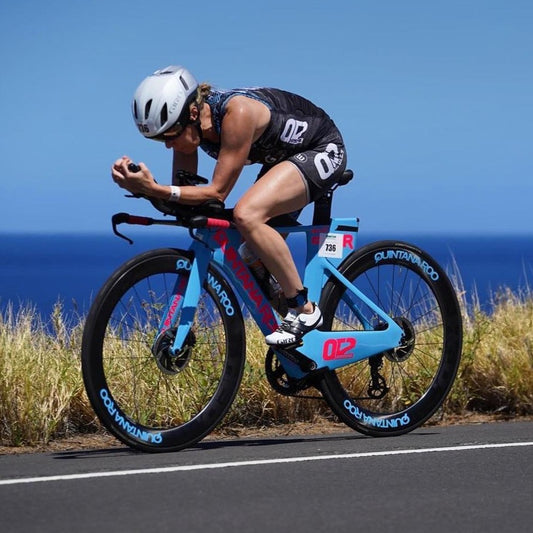
Happy Valley is earning a reputation fast. Three years old and already a North American Championship. That says something about the course and about the community behind it. Penn State shows up for this race — loudly — and that energy is real from the moment you park at Beaver Stadium on race morning to the moment you run through the tunnel onto the 50-yard line to finish.
The course is not easy. The bike will find you if you've been cutting corners on climbing. The run is mid-June in central Pennsylvania, which means heat and humidity are in play regardless of what the forecast says Wednesday. This isn't a PR-by-default course. It's a course that rewards patience on the bike and controlled aggression on the run.
This guide applies QT2's Five Cornerstones — Training, Restoration & Day-to-Day Nutrition, Fueling, Pacing, and Mental Fitness — directly to Happy Valley. Use it to build a race plan specific to this course, not a generic 70.3 template.
Swim
Bald Eagle State Park
Clockwise triangular loop
Rolling start · 1:10 cutoff
Bike
3,462 ft elevation gain
Hublers Ridge climb at mile 38
Run
Finishes on the 50-yd line
Inside Beaver Stadium
Training
If you're reading a course guide two weeks out, the fitness question is settled. You built what you built. The job now is to arrive sharp, not to squeeze in one more training block that your body can't absorb before race day anyway.
That said, Happy Valley should have shaped your preparation in specific ways. This isn't a flat, one-dimensional course. Three-thousand-four-hundred-sixty-two feet of climbing across 56 bike miles, followed by a two-loop run in June heat — that combination punishes athletes who trained in a bubble. If your long rides were on flat roads and your long runs were done in 55-degree mornings, this course will find the gaps.
What This Course Actually Demands
The bike is the race-defining discipline at Happy Valley. The first 37 miles have rollers that feel manageable — and that manageability is the trap. Athletes who surge every climb and soft-pedal every descent are bleeding energy at a rate that doesn't show up in their power file until mile 38. That's where Hublers Ridge begins. A three-mile sustained climb coming at the end of an already-hilly bike leg. Athletes who banked early pay here. Athletes who were patient collect.
The run is two loops through Penn State's campus. It looks flat on the map. It isn't. There are grade changes, and you will feel them more on loop two than loop one. The crowd is exceptional — Nittany Lion country shows up — but enthusiasm from spectators doesn't compensate for glycogen you already burned on the bike.
Logistics note: Happy Valley uses a point-to-point bike course with two separate transitions. You checked your bike in at Bald Eagle State Park. Your run gear bag is at T2 near Beaver Stadium. Race morning shuttles run from Beaver Stadium to the swim venue. Catch an early one. Traffic entering the park has delayed athletes in prior years — the race has started late to accommodate shuttles caught in congestion. Don't be the athlete trying to calculate whether you can make it on the later bus. Shuttles run from T2 (Beaver Stadium) to T1 (Bald Eagle State Park) from 4 AM to 6 AM. T1 transition opens at 5 AM. T1 parking entrance closes at 7:15 AM. The age group race starts at 7:05 AM.
Read the 2026 Official Athlete Guide → ironman.com
Restoration & Day-to-Day Nutrition
The 10–14 days before any race are where you either protect the fitness you've built or quietly erode it. Sleep quality, stress management, travel logistics, and daily nutrition all matter — not as individual variables but as a system. One bad night of sleep before the race is recoverable. A week of poor sleep, stress eating, and cross-country travel without enough transition time is not.
Happy Valley in June adds a specific consideration: central Pennsylvania heat and humidity. If you're traveling from a cooler climate — and many athletes are — your body hasn't been working in those conditions. Give it time. Arrive Thursday or Friday. Don't fly in Saturday morning and expect to race comfortably in conditions your physiology hasn't seen in weeks.
At those temperatures, wetsuit legality is borderline. The reservoir in June at Happy Valley has historically sat right at the edge — 75.7°F in prior years. A warm week before the race could push it into wetsuit-optional territory. Have a plan for both. Don't make your race-morning decision based on what you see other athletes doing. Make it based on what you've practiced.
Race Week Nutrition Framework
Days 7–3: Train and eat normally. No dramatic changes. Day 2: Slightly elevated carbohydrates, reduced fiber, familiar foods only. Day before: Carbohydrate-focused breakfast, then taper intake through the day. Night before: Small meal, nothing new, nothing your stomach hasn't seen. Race morning: Your tested pre-race protocol — the word "tested" is doing the work in that sentence.
Fueling
A fueling plan built in February in a 50-degree training environment is not a Happy Valley fueling plan. Heat and humidity slow gastric emptying, increase sweat sodium losses, and drive fluid requirements up — all while your carbohydrate oxidation capacity stays the same or slightly decreases. The math that worked in early spring training does not automatically transfer to a June race in Pennsylvania.
In 2026, IRONMAN has a new on-course reality: Precision Fuel & Hydration (PH 1000) handles all hydration at every IRONMAN and 70.3 globally, and Maurten handles fueling. Carbohydrates and fluids are now completely decoupled on course. If your race nutrition plan counted on a sports drink to cover both hydration and calories simultaneously, you have a gap. Address it before race day.
The QT2 Fueling Window Approach
The QT2 Fueling Window has always treated carbohydrates and fluids as independent levers — which makes it perfectly aligned with how IRONMAN courses are now configured. Know your carbohydrate target per hour. Know your fluid and sodium target per hour. Execute them separately. Don't conflate them.
PH 1000 will be available at all aid stations. It delivers 1,000mg of sodium per liter. That's your hydration anchor. Pair it with your carbohydrate source — whether that's Maurten gels on course or your own product carried on the bike — and you have both levers covered. The athletes who struggle on the run at Happy Valley almost always have a fueling problem, not a fitness problem. They built the engine. They just ran it dry.
Pacing
The swim at Happy Valley is as close to a non-event as a 1.2-mile reservoir swim can be. Calm water, two turns, easy sighting, rolling start with minimal contact. Execute your swim in aerobic control — not maximal effort, not survival mode. Get out of the water with your heart rate in a place that allows you to settle into T1 transitions cleanly. Your race doesn't start at the swim exit. It starts about 12 miles into the bike.
Bike Pacing: The Rolling Trap and the Hublers Ridge Test
The first 37 miles of the Happy Valley bike course have a rolling character that invites surging. Every climb feels short enough to push, every descent feels like recovery. That pattern is expensive. Variability Index is the metric — athletes who ride a VI above 1.08 on this course typically pay a measurable cost on the run. Ride smooth. Let the course come to you.
Hublers Ridge begins around mile 38 — a three-mile sustained climb after a bike leg that has already taken something from you. This is the defining moment of the race. If you paced the first 37 miles at 88–90% of your Functional Threshold Power, you have the resources to ride Hublers Ridge with discipline and arrive at T2 with something left. If you rode the first half at 93–95%, you'll be surviving by the top of that climb.
The official course map labels three climbs: Beaver Bluff in the early miles, Old Main Grind in the middle section, and Nittany Summit before the final approach to Hublers Ridge. None of them individually will break you. The cumulative effect of treating each one as something to attack will.
Miles 38–41 (Hublers Ridge): Hold effort. Do not dig. Ride the grade, not your ego.
Miles 41–56: Settle. Let the legs recover toward T2. Spin down the final miles.
Run Pacing: Loops and Landmarks
The Happy Valley run is two loops through Penn State's campus — the Nittany Lion Shrine, Old Main, past the Berkey Creamery (yes, you will smell it), and back. The crowd is loud and consistent throughout both loops. Do not let the crowd borrow energy you need for loop two.
Start the run conservatively. The first mile off the bike will feel deceptively good or deceptively bad — neither is a reliable signal of how the next 12 miles will go. Find your rhythm at mile two. Run loop one at a pace where loop two feels achievable. In June heat, that typically means starting 10–15 seconds per mile slower than your goal pace and letting the body arrive at speed, rather than forcing it.
The finish runs down Curtin Road and into Beaver Stadium through the tunnel. The noise is significant. The 50-yard line finish is one of the more memorable experiences in the sport. Save enough to appreciate it.
Mental Fitness
Happy Valley 2026 is a North American Championship race. The field will be larger and faster than in prior years. The professional prize purse is elevated. Age group slots to the Nice World Championship are increased. That context can either work for you or against you, depending on what you do with it.
The athletes who run into trouble at championship-level races typically do it early. They go out too hard on the bike because the field around them is going hard. They surge on Hublers Ridge because they don't want to lose contact with athletes ahead. They run the first loop of the run too fast because the crowd and the energy pull them forward. Every one of those decisions costs them later. The athletes who execute their own plan — their numbers, their pacing, their nutrition — regardless of what the field around them is doing, are the athletes still running strong at mile 10.
Pre-Race: What Confidence Actually Looks Like
Confidence before a race isn't the absence of nerves. It's the presence of a plan you've rehearsed. You know this course. You know your pacing targets. You know your fueling schedule. You've run the race in your head already — the swim start, T1, the rollers on the early bike, the decision point at Hublers Ridge, the first mile of the run. That rehearsal is the work. Race day is the execution.
When it gets hard — and it will get hard, likely somewhere in the second loop of the run in the heat — break the race into what's directly in front of you. Next landmark. Next aid station. Next mile marker. The Nittany Lion Shrine. The Creamery. The turn onto Curtin Road. One thing at a time. You've trained for this. Run through it, not around it.
When you come out of that tunnel into Beaver Stadium, the noise will be unlike most finish lines you've experienced. That moment belongs to you. Make sure you arrive there having raced your plan.
```Four Tiers. One Framework.
If Happy Valley is on your calendar this June — or you're building toward IMLP in July or Kona in the fall — now is the time to evaluate whether your current training structure matches the demand ahead.
Find Your QT2 Tier →