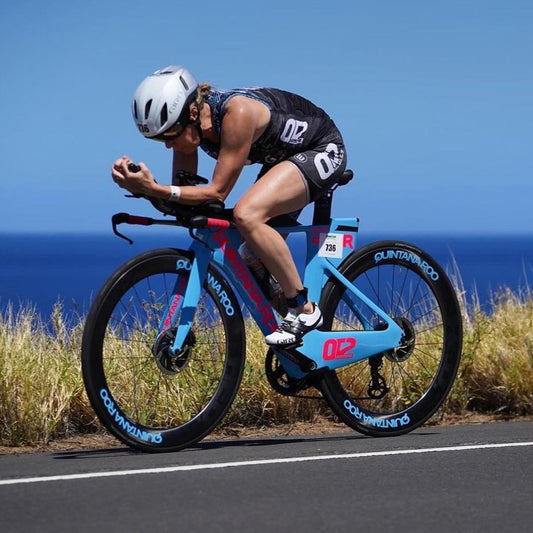
Most experienced athletes know the feeling. It is a week or so before a race you have been building toward for months, and your training has been cut back. You expected to feel fresh, but you feel flat and restless, and a quiet voice keeps asking whether you are losing fitness, whether you are putting on weight, and whether one more hard session would make you feel better about all of it. If you have raced for a few seasons, you have probably also lived through a taper that went sideways: either you cut back so far that you stood on the start line feeling dull, or you could not resist that extra session and carried the fatigue into the race.
That feeling is normal, and it is a big part of why we plan tapers the way we do. On our October coach call, the QT2 coaching team spent the evening on this problem. The way we taper has changed over the years, and the biggest change is not a new formula. It is how much of the final two weeks is now built by hand around the specific athlete in front of the coach. To see why, start with three numbers you have probably seen in TrainingPeaks.
Fitness, fatigue and form
Every session you log gets a Training Stress Score (TSS), a single number for how much stress that workout carried. Those scores feed three lines, and the whole taper is about how they move.
The first is fitness, which TrainingPeaks calls Chronic Training Load (CTL). It reflects the training you have absorbed over roughly the last six weeks, so it moves slowly. All season long, we are trying to build it, and in an ideal world the line climbs steadily from left to right.
The second is fatigue, or Acute Training Load (ATL). It reflects roughly the past week, so it reacts quickly. Fatigue is the cost of doing business. You cannot build fitness without accumulating it.
The third is form, or Training Stress Balance (TSB), which is simply the difference between your fitness and your fatigue. I think of TSB as access to your fitness. You can be very fit and still have no access to that fitness if you are buried under fatigue, which is why TSB tends to sit below zero during hard training. A positive TSB on race morning means your fatigue has dropped below your fitness, so you start the race able to use what you have built instead of fighting through what you are still carrying. The bigger the positive number, the more rested you are.
We also chart bike and run separately for every athlete, because a single combined number hides too much.
The dip we are after
As an A race approaches (the key race of the season; more on choosing those later), the athlete typically moves into Specificity (SP), the race-specific block that leads into the taper. Think of the moment on a plane, 20 or 25 minutes out, when you feel the engine ease off before the pilot announces the descent. We are no longer trying to grow fitness. We accept the fitness we have and focus on using it in the most race-specific way possible, and the CTL curve flattens out. Then comes the landing itself, which by default is a two-week taper. Fatigue plummets, we give back a small bit of fitness, and TSB swings positive. That is the taper dip, and it is the whole point: we trade a little fitness to shed a lot of fatigue. When athletes see their CTL tick down in those last two weeks and start to worry, the line to look at is the fatigue line. That drop is what they are going to race on.
Same shape, smaller size
Our older taper scheme pulled way back on a set pattern that had little to do with the event and did not preserve frequency or stimulus. What we do now rests on three ideas. First, keep the same kind of stimulus. If an athlete is in a 70.3 Specificity block, the taper keeps that 70.3 work, and if a 70.3 athlete has been in a Build/TH (BTH) block, or other, we keep that. Second, keep the same training frequency as much as possible, knowing that race week gets a little funky with travel. Third, shrink the magnitude of everything. If an athlete would normally ride 100 TSS on a Tuesday three weeks out, that same Tuesday ride might be 80 TSS two weeks out and 65 TSS in race week. Each taper week becomes a scaled-down "mini-me" of the athlete's normal week.
How that gets planned is where the coaching really shows up. During the season, we lean on StressLogic, the QT2 logic that helps us set each athlete's training load and dose, to do a lot of that work. For the final two weeks before an A race, the coach sets it aside and plans by hand. When I hit two weeks out, I enter daily bike and run TSS values first, without any workouts, until the projection lands on the race-morning TSB targets I want. In plain terms, I decide how much stress each day should carry before I decide what the workout is. Only then do I fill in the actual sessions, keeping the stimulus and frequency the athlete is used to. The race day itself stays blank in the calendar, because a planned race-day TSS would throw the whole projection off. In the swim there is no TSB target. We shorten the volume but keep the frequency and the intensity.
Then reality hits. Athletes miss sessions, and sometimes a planned three-and-a-half-hour ride two weeks out turns into a five-hour ride. So the coach checks where bike and run TSB are actually trending at about 10 days, 7 days and 4 days out, compares that against the plan, and remaps the remaining days if the athlete is drifting off target.
Where you land is personal
So what are we aiming for? To read the table below, find your race distance and read across to the race-morning TSB range for the bike and the run. A higher number means more rest, and longer races generally sit higher.
| Race distance | Bike TSB on race morning | Run TSB on race morning |
|---|---|---|
| Sprint | Positive, below the Olympic targets | Positive, below the Olympic targets |
| Olympic | +8 to +15 | +6 to +10 |
| 70.3 | +10 to +18 | +8 to +12 |
| IRONMAN | About the same as 70.3 (+10 to +18) | About the same as 70.3 (+8 to +12) |
| Marathon (standalone) | At least 0 for triathletes | +10 to +15 |
These are starting targets that your coach adjusts for each athlete.
That pattern reflects a long-standing QT2 philosophy: for a longer race, it is better to be rested than sharp, and for a shorter race, it is better to be sharp than rested. Flatness can be worked out early in a long race. Fatigue cannot. Even in a sprint, we want TSB positive so fatigue is not hampering the run, and for a triathlete who has been riding through a marathon build, I want the bike TSB at zero at the very least, so no leftover bike fatigue gets in the way.
Those ranges are a starting point, though, and the athlete in front of the coach decides where we land within them. Athlete type is the first lens. Older QT2 thinking sorted athletes as aerobic, balanced or anaerobic, based on our old profiling sheet, and that idea still informs our decisions. When a coach calls an athlete a "diesel engine," they mean someone who, in the coach's gut, is very aerobic by nature, and most of our athletes lean that way. An anaerobic athlete is not that diesel engine at all. The table below splits the 70.3 ranges by athlete type. Find the row that sounds most like you: diesel engines start toward the lower end, anaerobic athletes toward the top, and all-rounders in the middle.
| Athlete type (70.3) | Bike TSB on race morning | Run TSB on race morning |
|---|---|---|
| Aerobic ("diesel engine") | +10 to +13 | +8 to +9 |
| Balanced (all-rounder) | Middle of the range (coach sets) | Middle of the range (coach sets) |
| Anaerobic | +15 to +18 | +11 to +12 |
These are starting targets that your coach adjusts for each athlete.
The same lens can change taper length: two weeks is the default, but a very anaerobic athlete may need three, and a very aerobic athlete something closer to 10 days.
Fitness level is the second lens. If an athlete's CTL is low relative to the race distance, resting them up to the standard range costs too much. Losing three points from a bike CTL of 30 means giving back 10 percent of their fitness, while the same three points from a CTL of 60 is 5 percent, which we can afford. One of our case examples was a long-course athlete coming back from a run injury with a low run CTL. The coach removed one run, let the run land at about +5, and kept the bike in its usual range.
Life is the third lens, and it is the one the numbers cannot see. There is the TSB you plan, and then there is how that TSB behaves amid everything else going on. An athlete who works right up to Friday night before a Sunday race and barely gets the bike packed needs a higher planned TSB, so their real-life stress has something to chip away at. Long drives, big travel and sleeping away from home, which the body simply does not do as well the first night, all count. In another case example, an athlete was two weeks out from a 70.3 A race with a projected bike TSB of -4 and run TSB of -10. The coach kept the normal weekly layout, trimmed the key and quality sessions into mini-me versions, removed the long ride in race week, and aimed near the top of the 70.3 range because the athlete was traveling to the race.
Finally, every athlete responds a little differently. If someone races best at +7 to +10 instead of +10 to +18, that is fine. We are much more likely to discover it because we started with a stake in the ground, and that gives us good reasoning instead of guesswork or a "this worked for me" approach. It is where art meets science.
Which races earn it, and how race week should feel
We grade races A, B and C. An A race is a key race that gets the full taper. A B race matters, but it is lower priority, and it is a good chance to test fueling and equipment. A C race is an early-season race done for fun and motivation. Realistically, an athlete gets two, maybe three A races a year, and every true taper gives back some fitness that has to be rebuilt. So part of your coach's job in your 1-1 planning conversations is to help you decide which races earn the full treatment. For a B race, we aim for the A targets of the next-shorter distance from the first table. A 70.3 B race uses the Olympic targets, an Olympic B race uses the sprint targets, and a sprint B race gets essentially no taper. There is no such thing as a B IRONMAN. C races get no TSB target, but we still shed a little fatigue over the final 3 to 5 days rather than training straight through them.
Race week itself has a few fixed points. The long ride comes out, because the race is the long ride. I usually like a short, easy ride the day before, mostly to make sure the machine works, although it depends on the athlete. Some athletes may need a little extra stimulus in that session, what coaches call an opener, and that is a call the coach makes for the individual.
Which brings us back to that flat, restless feeling from the start. Plenty of athletes go a little crazy during a taper, convinced they are losing fitness or gaining weight. We care how you feel on race day, not eight days out. Flatness usually comes from one of two places, fatigue or rust. Fatigue cannot be fixed on race morning. Rust can be shaken off once the race gets going. If we have followed a sound taper, we can point to the numbers and feel confident that whatever you feel early on is not fatigue.
All of this sits inside a bigger idea I come back to constantly: we are always trying to apply the maximal amount of appropriate training stress. "Appropriate" has to fit within your whole stress budget, and training is the one piece of that budget you actually get to choose. The default ranges give your coach a starting point, and the hand-built final two weeks are where they fit those ranges to you.